The pictures and game lists aren't built yet. Run npm run assets to build them from your copy of the game (see README.md).
Game wiki · Game Boy Advance · 2003
Final Fantasy Tactics Advance
A guide to Ivalice and how the game plays: the five races and 34 jobs, abilities learned from equipment, battles refereed by judges, laws and penalty cards, clans, and around 300 missions.
Title screen
Overview
Final Fantasy Tactics Advance (FFTA) is a turn-based tactics game. You lead a clan of up to two dozen fighters across Ivalice. You take missions from town pubs and fight engagements on isometric maps, where units move on a grid and act in turn order.
Three systems set it apart from other tactics games:
Judges and laws. Nearly every battle has a judge who enforces the day's laws: forbidden weapons, elements or actions. Breaking one earns a yellow or red card, and enough cards send a unit to prison.
Abilities from equipment. Weapons and armor carry abilities. Fight while wearing them to earn ability points (AP), and once an ability is mastered the unit keeps it.
Race decides jobs. Humans, bangaas, nu mou, vieras and moogles each have their own set of jobs. Advanced "expert" jobs open up as a unit masters abilities in the basic ones.
Between battles you build the world map yourself, placing each new location's symbol where you like. Rival clans fight you for turf, and the in-game news reports on all of it.
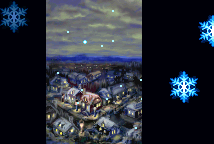
“It was a day like any other…”St. Ivalice at nightA snowy streetA house at nightA bedroom
Story
Marche is the new kid in the snowy town of St. Ivalice. After a snowball fight at school, he and his classmates Mewt and Ritz find an old book. That night, the town wakes up as Ivalice, a world of magic, clans and laws. Each of them gets something they wished for. Marche wants to go home.
Plot details (spoilers)
Marche joins a clan with the moogle Montblanc and learns that Ivalice is held together by crystals, each guarded by a totema. Destroying the crystals would restore the real world. Mewt has become the prince of Ivalice. His late mother returns as Queen Remedi, and his father Cid is the Judgemaster. Marche's brother Doned can walk in Ivalice and has no wish to leave.
Along the way the clan crosses Clan Borzoi, the Redwings, the royal mage Babus, the nu mou card-maker Ezel, who deals in antilaws, and the palace enforcer Llednar. The road ends at Ambervale, where the queen's true nature, and that of the book, is revealed.
Story-mission titles from the game's mission table trace the arc: Snowball Fight · Another World · Cid's Message · Meeting Doned · I'm Ezel! · Llednar · With Babus · Ritz's Offer · Left Behind · Decision Time.
MarcheThe new kid in St. Ivalice, and the hero
MewtA shy classmate who finds the book
RitzA classmate who speaks her mind
Mr. LeslaieThe teacher who starts the snowball fight
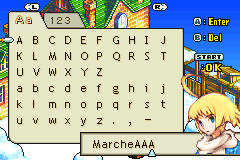
The first battle is a school snowball fight, played with the same rules as every engagement after it.Naming the hero. Marche is the default name.
Principal characters ROM
Marche
Mewt
Ritz
Doned
Montblanc
Remedi
Cid
Babus
Ezel
Llednar
Races
A unit's race fixes which jobs it can take and which totema it can summon. The game's help text puts it plainly:
Human
11 jobs · totema: Ultima
Balanced, with the widest range of jobs: soldiers and paladins, thieves and ninjas, mages of four kinds, archers and hunters.
Bangaa
7 jobs · totema: Adrammelech
Lizard-like and physically strong. Warriors and dragoons, armored defenders and gladiators, monks, bishops and templars.
Nu Mou
8 jobs · totema: Exodus
Long-lived scholars with strong magic: time, illusion, alchemy and sage magic, plus monster-handling beastmasters and morphers.
Viera
8 jobs · totema: Mateus
Swift, perceptive forest dwellers. Fencers, elementalists, red mages, summoners, archers, assassins and snipers.
Moogle
8 jobs · totema: Famfrit
Small and inventive. Animists, mog knights, gunners, jugglers and gadgeteers, plus thieves and mages.
Monsters form a sixth group. They can't change jobs, but they can be captured into the Monster Bank, controlled by beastmasters, and morphed into by morphers.
Jobs
Every race starts with a few basic jobs. Mastering abilities in those jobs unlocks expert jobs:
A unit uses its current job's command set, plus one secondary command set from any other job it has learned abilities in. Its job also shapes how its stats grow at each level.
Every job in battle ROM
The standing sprite for each of the 42 race and job pairs, decoded from the game's own sprite data and palettes. The same job looks different on each race.
Ability names are as they appear in the game. The selection per job is a representative one, not a complete list.
Abilities
FFTA has four kinds of ability. In the game's words:
Type
What the game says
Action (A-ability)
“Standard actions, like Black Magic or Monk Tech.” Used from the Action menu; one primary and one secondary set.
Reaction (R-ability)
“Dodging or striking back when attacked.” One equipped, triggers on its own (Counter, Reflex, Return Fire, Block Arrows…).
Support (S-ability)
“Enhancement abilities such as Double Sword.” One equipped, always on (Doublehand, Monkey Grip, Turbo MP, Immunity…).
Combo
“Abilities triggered when an ally uses a combo.” Costs JP; allies with a combo ability join in.
Learning abilities: AP
An ability tied to a piece of equipment can be used only while it's equipped, and only if the unit's job has that ability. Each completed engagement adds AP toward it. When the AP total reaches the ability's mastery value, the ability is learned permanently and the equipment can go.
Combos and JP
Judges award Judge Points (JP) for knocking out enemies. JP pays for combos and totema summons.
All 29 combo abilities ROM
Totema
Totema
Race
Summon
Ultima
Human
Ultima
Adrammelech
Bangaa
Adrammelech
Exodus
Nu Mou
Exodus
Mateus
Viera
Mateus
Famfrit
Moogle
Famfrit
A totema is earned by defeating it in the story. A unit of its race with enough JP can then summon it.
Morphing
Engagements
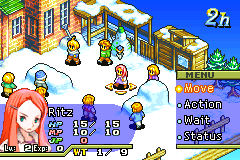
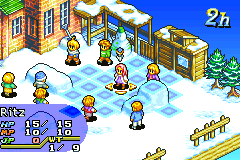
A battle is an engagement. Units act in an order set by their speed, shown on the Turn Order screen. On its turn a unit can Move and take an Action in either order, then Wait and pick a facing direction. Facing matters: attacks to the side and back hit more often. Status shows a unit's details, and Mission shows the win condition.
Ritz's turn: HP, MP and JP in the panel, and the four commands.Choosing Move lights up every tile the unit can reach.
Battle menu ROM
Move
Action
Wait
Status
Turn Order
Mission
Laws
Law Cards
Totema
Combo
Flee
Save Now
Knocked out, not dead
With a judge present, a unit at 0 HP is knocked out and comes back after the battle. In the three jagds (Jagd Dorsa, Jagd Helje and Jagd Ahli), lawless zones with no judges, a unit left knocked out at the end of the battle is lost for good. With no judge, there's also no JP and no laws.
Engage or negotiate
Laws and judges
Laws change as the days pass. At any time, one or two are in force, each forbidding something. A judge on a chocobo watches every engagement outside the jagds. A unit that breaks a law is penalized on the spot:
Yellow card
“A minor infraction gets you a yellow card.” It goes on the unit's record, and penalties grow with that record.
Red card
“A major infraction will earn you a red card.” The unit is removed from the battle and sent to prison.
“Whichever penalty card you get, it'll go down on your record — and the more cards on your record, the steeper your penalty becomes, so watch out!”
Prison
Prison menu options in the game: Release, Pardon, Bail, Sentence. Some units carry Prison Exemption: “a special law that turns all their red cards yellow! You can tell one by the ribbon they wear… the lucky bums.”
Law ranks and cards
Laws are ranked by strictness: “[R7] laws are easy,” and each rank above is harsher. Collected law cards change the rules:
White cards add a law.
Black cards, or antilaws, cancel a law: “and the judges can't do a darn thing about it!” Antilaw cards come in ranks matching the laws they can cancel.
Blank cards appear later, and the news blames them for laws springing up everywhere.
Cards are bought, won and traded at the Card Keeper. Some abilities also act on laws: Lawshift, Judgement, Advanced Law.
What laws can forbid ROM
The game's law table names everything a law can forbid:
Laws on damage and healing amounts, and on healing at all
Status effects
Petrify, Frog, Poison, Confuse, Berserk, Silence, Charm, Addle, Slow, Stop, Shell, Protect, Haste, and status effects in general
Targets
Damaging a Human, Bangaa, Nu Mou, Viera, Moogle, or an animal
Other
Law Cards, and color magic
Missions built around odd laws show the idea: No Arms Rule · Kissing Rule · Immunity Pass · No Full HP · No Literacy · Favoritism · No Answers · No Jumping.
Status effects and elements
Status
Effect
Cure
KO
Out of the fight at 0 HP; recovers after battle when a judge is present
Phoenix Down, Raise, Life
Poison
Loses HP every turn
Antidote
Blind
Physical attacks usually miss
Eye Drops
Silence
Can't cast spells
Echo Screen
Frog
Turned into a frog: weak, few abilities
Maiden Kiss
Petrify
Turned to stone, can't act
Soft
Sleep
Can't act until hit or it wears off
Wears off
Confuse / Berserk / Charm
Acts on its own, attacks wildly, or fights for the other side
Positive: faster turns, less physical or magic damage, spells bounce back, HP every turn, blocks the next status effect, revives once
—
Elements: Fire, Ice, Lightning, Holy, Wind, Earth, Water and Dark. Monsters and equipment can be weak to, resist or absorb each one, and laws can forbid them. Spells come in tiers (Fire, Fira, Firaga) and elemental attacks are everywhere: Elementalist spirit magic, Gladiator spellblades (Fire Sword, Bolt Sword, Ice Sword), Gunner shots (Fireshot, Boltshot, Iceshot) and dragon breaths.
Clans
Your clan is your party, your reputation and your business.
The eight skill levels ROM
Combat
Magic
Smithing
Craft
Appraise
Gather
Negotiate
Track
Completing a mission raises the skills it uses, and many missions require a minimum level in one of them.
Turf
Holding turf brings discounts and special deals at that area's shops and pubs. The news describes the clan wars over it as “never fiercer.” Rival clans show up on the map; you can engage them or negotiate. Clan Borzoi is the first big rival.
Linking
Over a link cable two players can “fight together, trade items, and even trade clan members!” Some trade items only appear at the shop if you link often.
Missions
Pubs in each town post requests. The game's mission table has about 380 titles: the roughly 300 numbered missions, plus area-defense requests, wanted posters and race-specific recruitment calls. They come in a few kinds:
Engagements: battles, story or side quest, against monsters, clans or bounties.
Dispatch missions: send one member away for a set number of days. Success depends on their job, level and the clan's skill levels.
Area defense: “Help Giza!”, “Help Kudik!” and the rest, when a monster or clan threatens an area on your map.
Encounters: rival clans and roaming monsters met while traveling.
Link missions: played together over the link cable.
Mission items
Rewards are gil, equipment, AP, mission items, and new location symbols for the world map. Pubs also share rumors and the news; see Lore.
World map
The map starts nearly empty. After certain missions you receive a location symbol and place it on any open square. Where you put towns and areas changes travel times and which treasures appear:
Each area is one of seven terrain types (plains, forest, desert, marsh, mountain, cave or town), and the jagds are a type of their own. Towns have a shop, a pub, a prison, a card keeper, and the Monster Bank.
Places ROM
Kind
Places
Capital
Bervenia Palace
Towns
Cyril · Sprohm · Muscadet · Cadoan · Baguba Port
Areas
Jagds (lawless)
Jagd Dorsa · Jagd Helje · Jagd Ahli
Final area
Ambervale
Time passes as you travel: each step on the map takes a day, and dispatched members come back after a set number of days. The months have names; the ones in the game's text include Kingmoon, Madmoon, Sagemoon, Huntmoon and Bardmoon.
Equipment and items
Each unit has slots for weapons, a shield, headgear, body armor and accessories. Which gear a job can equip decides which abilities it can learn. Weapon type matters for laws too: a day that forbids Swords empties a lot of hands.
Category
Count ROM
Examples
Weapon typesROM: Swords, Blades, Sabers, Knightswords (paladins), Greatswords, Broadswords, Knives, Rapiers (fencers), Katanas, Bows and Greatbows, Spears, Instruments (animists), Knuckles (white monks), Souls (morphers), Guns (gunners), Staves, Rods and Maces. Many weapons have a Mythril version, and famous names appear across types: Excalibur, Ragnarok, Masamune and Masamune 100, Zanmato, Kikuichimonji, Onion Sword, Max's Oathbow.
Consumables
Item
Use
Potion · Hi-Potion · X-Potion
Restore HP, in increasing amounts
Ether
Restores MP
Elixir
Fully restores HP and MP
Antidote · Eye Drops · Echo Screen
Cure poison, blind, silence
Maiden Kiss · Soft · Holy Water
Cure frog, petrify, zombie
Bandage
Cures immobilize and disable
Cureall
Cures most status effects
Phoenix Down
Revives a knocked-out unit
Beyond those, the item list holds over a hundred trophies, medals, ores, hides, foods, books and keepsakes. They're used as mission items, sold, or turned into new equipment. Examples: Magic Trophy, Elda's Cup, Rainbowite, Zodiac Ore, Adaman Alloy, Chocobo Egg, Gysahl Greens, Malboro Wine, Monster Guide, Stuffed Bear, Stradivari, the four Sigils, Helje Key.
Classes and monsters
The game's unit-class table lists every playable job together with every monster family and special enemy. Monster families share a sprite and differ by palette: the Goblin and Red Cap, the Bomb and Grenade, the three drakes. Their battle sprites ROM:
Special and boss classes include Judge, Judgemaster, Totema, Li-grim, Battle Queen, Dark Knight, Ark Knight, World Wyrm, Rune Knight, Dread Lord, Swordmaster, the Borzoi Capo and Boss, and clan bosses such as the Hel, Gelm, Kagle and Fes bosses. A few school classes from the opening survive in the table: New Kid, Librarian, Class Head, PE Head, Nurse, Custodian.
The Monster Bank in town keeps the monsters you capture; you can give them items or release them. Blue mages learn abilities by being hit by monsters, and morphers borrow them through souls.
Lore from the news
Pubs carry a running newspaper. These articles are quoted from the game:
Searchable index
Every ability, mission and piece of equipment named in the game's tables.
Sources
The battle sprites are decoded directly from the cartridge's sprite and palette tables. The other pictures are screenshots of the game running from the same cartridge, taken in the decompilation's native port, with the portraits cropped from dialogue scenes.
Everything marked ROM, and every quotation, comes from the US cartridge of the game (game code AFXE). It was decoded directly from the game's text and name tables, so the spellings are the game's own, including run-together names such as “SaveTheQueen”. The explanations of mechanics combine the game's help text with how the game is widely known to play. Character relationships, the totema for each race, status-effect details and the per-job ability selections come from that knowledge rather than from a table in the game.




 MarcheThe new kid in St. Ivalice, and the hero
 MewtA shy classmate who finds the book
 RitzA classmate who speaks her mind
 Mr. LeslaieThe teacher who starts the snowball fight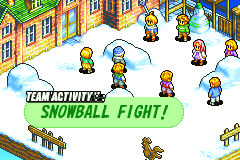
 Human
Human Bangaa
 Nu Mou
 Viera
Viera Moogle